
by Kathleen Dickey
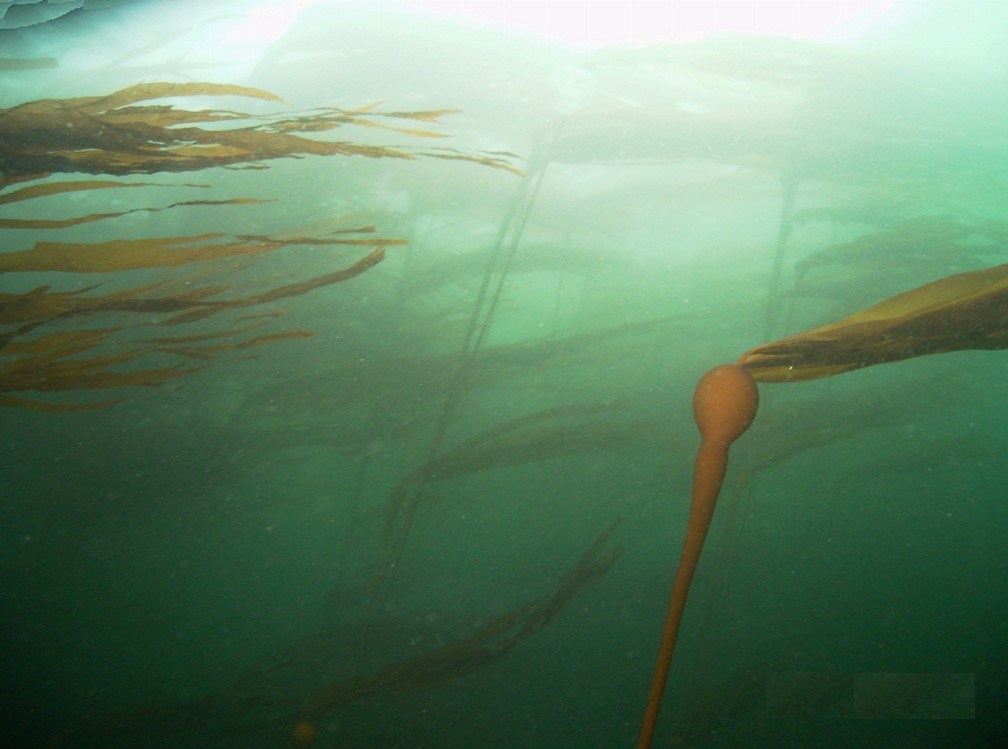
A few years back a boulder was brought into a marine lab from the submerged sea mountains called Cordell Banks, just off Bodega Head. To the surprise of the scientists in the lab, within weeks tiny “sporlings” of bull kelp had sprouted. As far as anyone knew, the rock had been in the cold and dark for many years.
We in La Honda are lucky to have rich and diverse tide pools within a half hour’s drive. We can find the familiar heads of the bull kelp in the drift of most any beach, especially after a storm. Our local kelps share with other seaweeds and marine invertebrates versatile life cycles, in which a microscopic stage alternates with the more familiar, visible stage. They resemble ferns and mosses in this aspect.
The alternate stages of ocean life have different requirements in terms of light, temperature, and pH. One result of these differing requirements is that an organism is not competing with itself for the same limited resources. Another is that a plant or animal can wait in one phase until conditions are just right to grow.
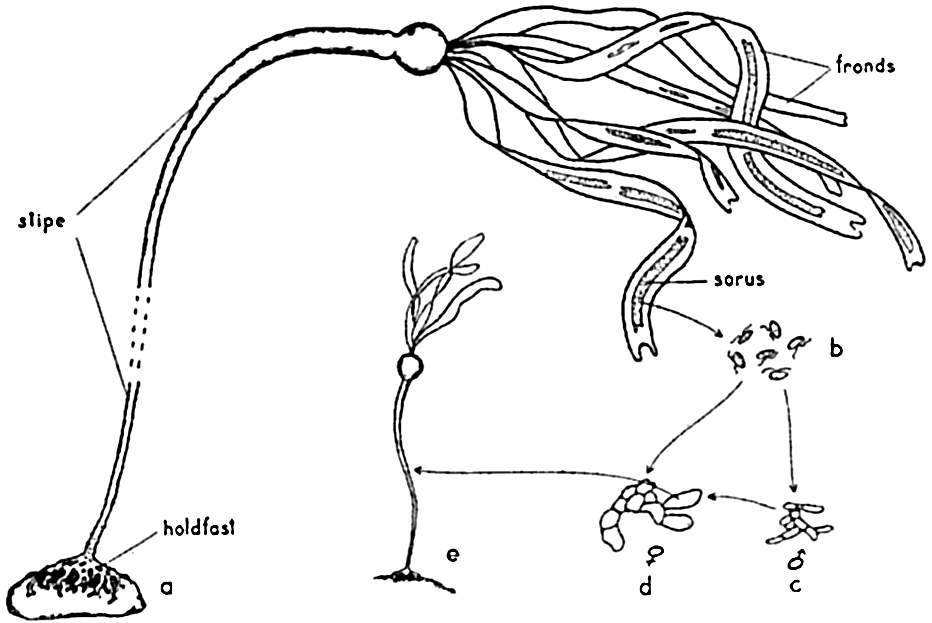
The microscopic spore stage of the bull kelp, Nereocystis leutkeana, responds to light by swimming away from it.
This phenomenon is called being “negatively phototactic”. But once the spores settle and are fertilized, the fledgling plant starts to grow towards the light. It is an annual plant, and can grow up to 17 meters in just a few months.
These are just some of the traits that have allowed the kelps to survive for many millennia.
(Originally published in the La Honda Voice, September 2011)